Reference / The language of form
Hakama glossary.
A clear starting point for the cuts, parts, techniques and practices behind our design studies. 19 terms, in 5 groups.
Traditional hakama and contemporary hakama-inspired trousers are related, but they are not interchangeable. These definitions name the parts and forms you will see across the collection. Start with the hakama guide for the main differences, or compare styles in our hakama collections.
01 / Garment & Form
Garment & Form
Names for the garment, its cuts and its visible parts.
- Hakama袴
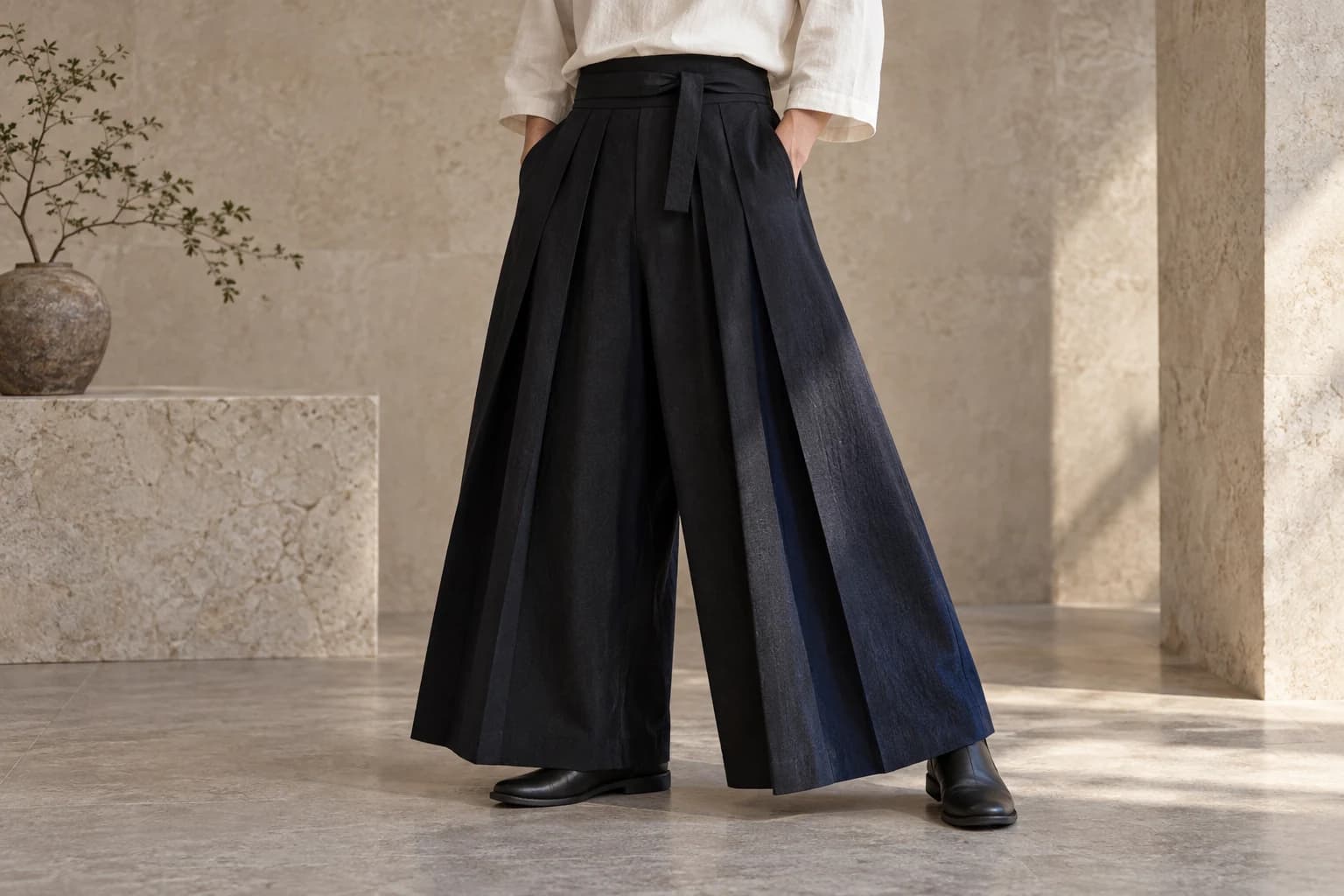
- A pleated Japanese lower-body garment. Traditional versions are worn with a kimono-style upper garment; contemporary fashion may borrow its volume and pleat structure without being a traditional hakama.
- Umanori
- A divided-leg hakama form. It has two leg sections, although its broad pleats can give a skirt-like appearance when standing still.
- Andon
- An undivided, skirt-style hakama form. It is distinct from the divided-leg umanori form.
- Pleat
- A fold that creates the hakama's characteristic structure and visual rhythm. A traditional hakama carries seven deep pleats — five at the front, two at the back — though placement and number vary between designs.
- Seven pleats, explained
- Kimono着物
- The T-shaped Japanese robe worn as the upper garment above a hakama. The name reads literally as "thing to wear".
- Obi帯
- The sash worn with a kimono. Where a hakama is worn, the obi sits beneath it, and the hakama is secured over the top by its own himo.
- Keikogi稽古着
- The practice jacket worn with a hakama in several martial arts. Often shortened to gi. Weight and weave vary by discipline.
- Hem
- The finished lower edge of the leg. On a wide, pleated trouser it is where the whole silhouette resolves — the drop, the break over the shoe and the width of the opening are all read at the hem, which is why it is the measurement most often judged wrongly by eye.
02 / History & Origin
History & Origin
Places, eras, and movements that shaped the Hakama tradition.
- Bushidō武士道
- The code of conduct associated with the samurai class. The hakama's seven pleats are commonly read as its seven virtues — a traditional association rather than a documented origin.
- Heian period
- The era of Japanese court culture to which the hakama form is usually traced. From there the garment spread across classes and professions rather than remaining court dress.
03 / Materials & Technique
Materials & Technique
Fabrics, stitches, and craft vocabulary used in production.
- Koshiita
- The structured back waist panel found on many traditional hakama. Its shape and firmness vary by garment and intended use.
- Himo
- The long waist ties used to secure many traditional hakama. Tie configuration varies with the garment and practice.
- Aizome藍染
- Japanese natural indigo dyeing. It produces the deep blue-black associated with traditional workwear and martial-arts garments, and it fades and softens with wear rather than staying flat — the reason aizome pieces are so often described as ageing well.
- Sashiko刺し子
- A running-stitch technique used to reinforce and mend cloth, originally out of thrift. Its even rows of stitching are now as much a visual language as a repair.
- Tetron
- A synthetic-fibre trade name used in hakama fabric descriptions, often for polyester blends. The name alone does not establish fibre percentages or care requirements; check the individual garment specification.
04 / Patterns & Symbols
Patterns & Symbols
Traditional Japanese pattern names, where relevant to a garment.
- Wagara和柄
- The traditional Japanese pattern vocabulary — repeating geometric and natural motifs, each with its own conventional associations.
05 / Culture & Subculture
Culture & Subculture
Movements and aesthetic references in Hakama culture.
- Kendō剣道
- The Japanese martial art of fencing with a bamboo shinai. Practised in a keikogi and hakama, and one of the disciplines in which the divided umanori form remains standard.
- Umanori
- Iaidō居合道
- The Japanese martial art centred on drawing and cutting with the sword in a single motion. Hakama are standard practice dress.
- Aikidō合気道
- A Japanese martial art built on redirecting an attacker's movement. In many styles the hakama is worn by higher grades, though the convention varies by school.
For traditional practice garments, always follow the guidance for your discipline and the specifications of the actual item. Nothing on this page describes a Hakama Pant product — it describes the vocabulary.