Find your form
How to measure for hakama.
Compare a garment that fits with the measurements for your chosen product. Size labels vary between cuts, so check the measurement method as well as the numbers.
Garment measurements
Standard garment measurements: waist and hip are full garment circumference; rise, outseam and inside leg are measured flat along the seam. Inside-leg figures apply to divided-leg cuts.
| Size | Waist (in) | Hip (in) | Rise (in) | Outseam (in) | Inside leg (in) |
|---|---|---|---|---|---|
| S | 30 | 42 | 13.5 | 38.5 | 25.5 |
| M | 32 | 44 | 14 | 39.5 | 26 |
| L | 34 | 46 | 14.5 | 40.5 | 26.5 |
| XL | 36.5 | 48.5 | 15 | 41.5 | 27 |
| XXL | 39 | 51 | 15.5 | 42 | 27 |
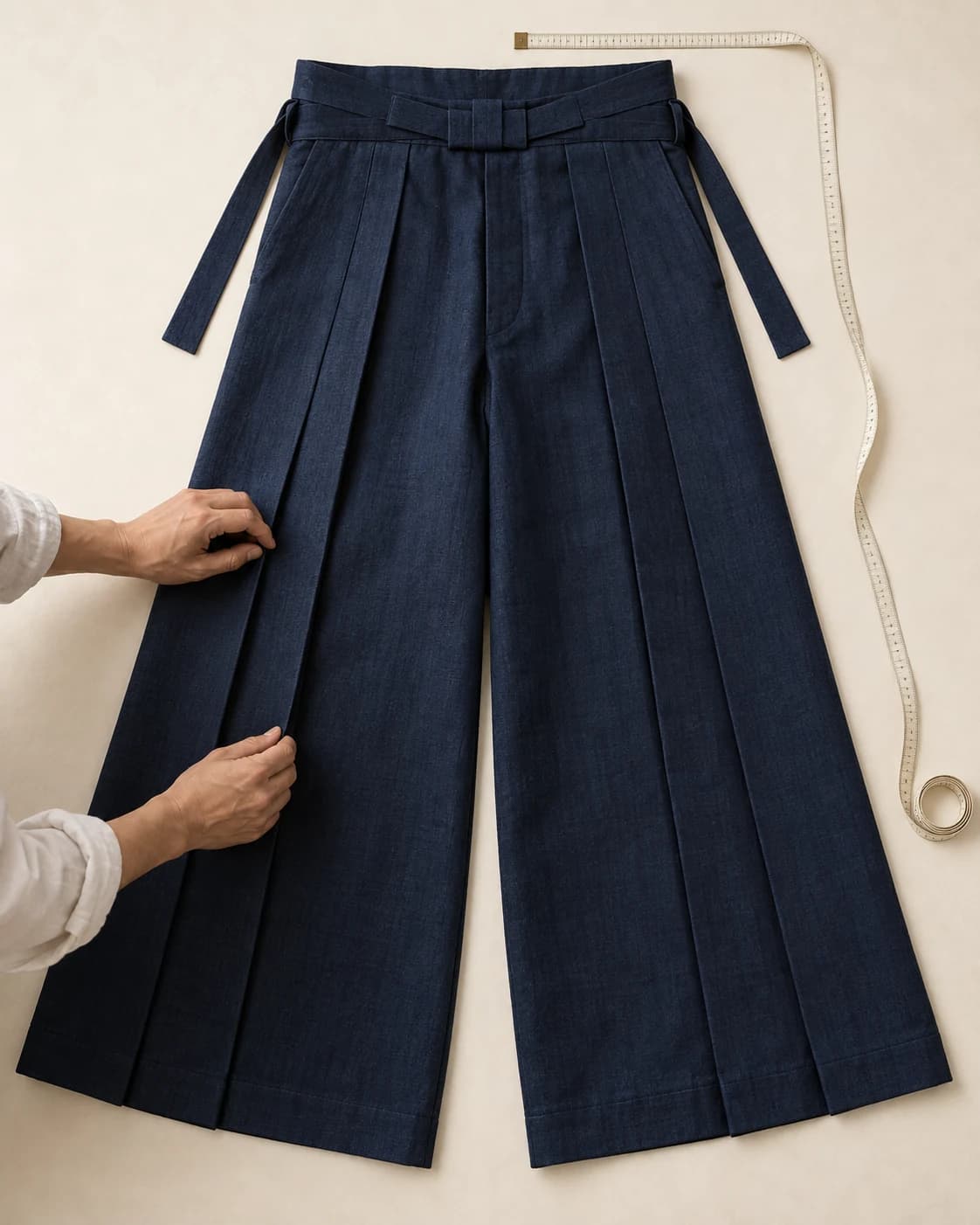
Before you start
- A soft tape measure — not a rigid rule, and not a phone app.
- A pair of trousers you already like, laid flat on a table.
- The shoes you intend to wear with the piece.
- Somewhere to record measurements and whether each is a flat width or circumference.
Quick conversion
- 1 in
- 2.54 cm
- 1 cm
- 0.39 in
- ½ in
- 1.3 cm
Five measurement references
How to measure.
Each one states what it decides, how to take it, and the mistake to avoid.
Waist
Decides: Where the garment sits, and whether it stays there
Lay a comparable garment flat and measure straight across the waistband. Record whether this is a flat width or a full circumference. For an elastic waist, record relaxed and stretched measurements separately.
Watch out — Do not compare a flat waistband width directly with a body circumference. Confirm the waistband construction and measurement method for the product.
Hip
Decides: Room through the seat
With the garment flat, measure straight across the hip area. Record the distance below the waistband where you measured, so the comparison uses the same position.
Watch out — Keep pleats in their resting position. Confirm whether the product chart gives flat width or full circumference.
Rise
Decides: The distance from waistband to crotch
For front rise, measure from the crotch seam up the front seam to the top of the waistband. Record back rise separately if it is provided.
Watch out — Front rise and back rise are different measurements. Do not add them together to compare with a front-rise figure.
Outseam
Decides: The outside length
Measure along the outside of the garment, from the top of the waistband to the hem. Use the same start and end points when comparing two garments.
Watch out — Outseam includes the distance above the crotch. It is not interchangeable with inside-leg length.
Inside leg
Decides: The length from crotch to hem
On a divided-leg garment, measure along the inner leg from the crotch seam to the hem. Compare with trousers of a similar cut.
Watch out — A skirt-style hakama has no inside leg. Ask for the appropriate length measurement for that style.
If you are between sizes
Compare the whole garment.
Check waist, hip and length together. A size label alone cannot tell you how a particular cut will fit. Use product-specific measurements before deciding.
Adjustable waist: confirm the actual adjustment range. Do not assume ties or elastic will accommodate a different size.
Sets and skirt styles: a trouser chart does not describe every piece. Ask for separate top measurements for a set and the relevant length for an undivided skirt.
Still unsure: send us the product name and your measurements, including the units and how you took them.
Ask about fitCommon measurement questions
Sizing & conversion FAQ.
- How do I convert a flat waistband measurement to circumference?
- Multiply a flat waistband width by two to estimate the unstretched inner circumference, then compare both the relaxed and stretched range against a garment you already wear comfortably.
- What is the difference between outseam and inside leg on hakama?
- Outseam measures from the top of the waistband down the outside of the leg to the hem and determines overall drop; inside leg (inseam) measures from the crotch seam to the hem on divided trousers and does not apply to undivided andon skirt cuts.
- Can I use a standard martial arts go sizing chart for streetwear hakama?
- No. Traditional martial arts go sizes measure from the bottom of the obi to the ankle bone, whereas modern elasticated or pleated wide-leg trousers use letter sizes (S–3XL). Always verify the product-specific measurement method before ordering.
- What should I do if I am between two letter sizes?
- Compare waist, hip, rise, and outseam together against a well-fitting pair of wide-leg trousers laid flat, or send your measurements and the product name to customer support before placing your order.
Using the S–XXL size chart
The standard S–XXL chart above lists full garment circumference for waist and hip and flat seam length for rise, outseam and inside leg. Inside-leg figures apply to divided-leg cuts; undivided Andon styles follow outseam length. If you are between two sizes or need help choosing for a set, contact us before ordering.